NHS Activity Tracker: February 2026
Acute sector
2.32 million
A&E attendances in January
71,517
patients waited at least 12 hours from the decision to admit to admission
13.1%
of attendees waited over 12 hours in A&E
A&E attendances
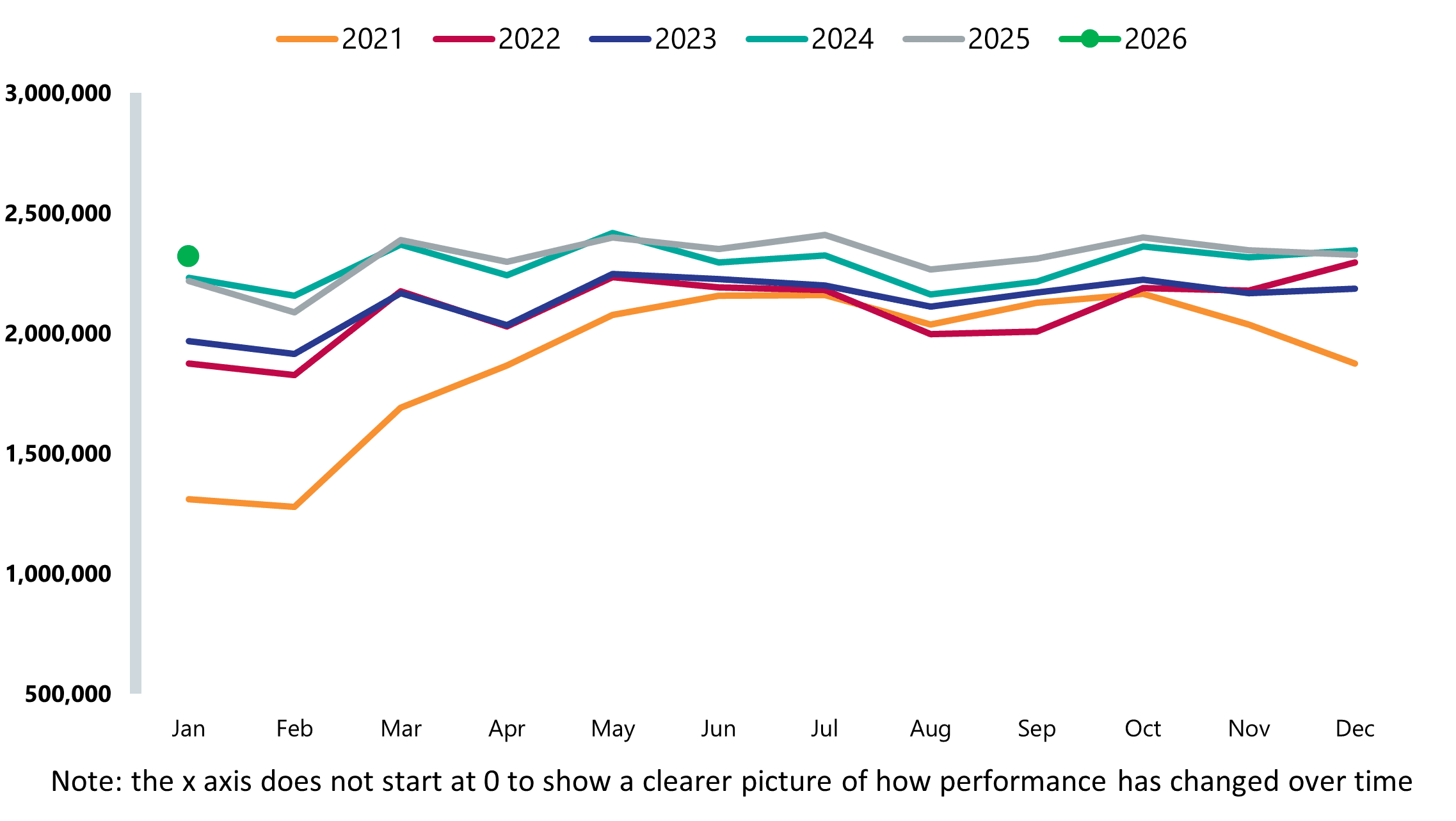
- There were 2.32 million A&E attendances this month, compared with 2.33 million in December. This value stood at 2.22 million in January 2025. This is the highest January on record. This is shown in Figure 1.
- 72.5% of patients were seen within four hours, compared with 73.8% in December. Performance was below January 2025 (73.0%) and below the 78% aim set for March 2026 in the 2025/26 planning guidance.
- New, experimental data on performance in type 1 and 2 A&E departments shows that 58.1% of patients were admitted, transferred or discharged within four hours, which is notably lower than the overall four-hour performance.
Figure 1
Total A&E attendances
A&E emergency admissions
- There were 546,136 emergency admissions, compared with 548,775 in January 2025.
12-hour waits in A&E from decision to admit to admission
- 71,517 patients waited at least 12 hours from the decision to admit to admission, compared with 61,529 in January 2025. This is the highest month on record (since August 2010).
12 hours in an emergency department (ED) from arrival
- 192,168 patients waited more than 12 hours from arrival at a type 1 & 2 A&E in January, compared with 178,318 in January 2025. This is the highest month on record (since February 2023).
- Waits of over 12 hours in A&E occurred 13.1% of the time, falling short of the 10% aim outlined in the UEC delivery plan published in June. This is the highest month on record (since February 2023).
Acute discharge delays (data for January 2026)
- On average, 59.84% of patients who no longer met the criteria to reside remained in hospital, compared with 59.0% for January 2025.
Cancer (data for December 2025)
- 77.4% of patients were told they have cancer, or cancer was definitively excluded within 28 days of urgent referral (FDS) compared with 78.0% in December 2024. The March 2026 aims set out in the 2025/26 planning guidance is for this figure to be 80%.
- 92.5% of patients waited less than a month from a decision to treat to first treatment (31-day target) compared with 91.6% in December 2024. The operational standard is for this to be 96%.
- 71.9% of patients waited less than two months from an urgent suspected cancer referral to a first definitive treatment (62-day target), compared with 71.1% in December 2024. The March 2026 aims set out in the 2025/26 planning guidance is for this figure to be 75%.
Diagnostics (data for December 2025)
- 2.37 million diagnostic tests were carried out this month, compared with 2.45 million in November.
- The waiting list reached 1.74 million, compared with 1.56 million in December 2024. It was 1.00 million in December 2019, indicating sustained strain on diagnostic services since the pandemic.
- 75.2% of patients were seen within six weeks for diagnostic tests, compared with 77.2% in December 2024. The constitutional standard for this metric is 99%.
Elective waiting list (data for December 2025)
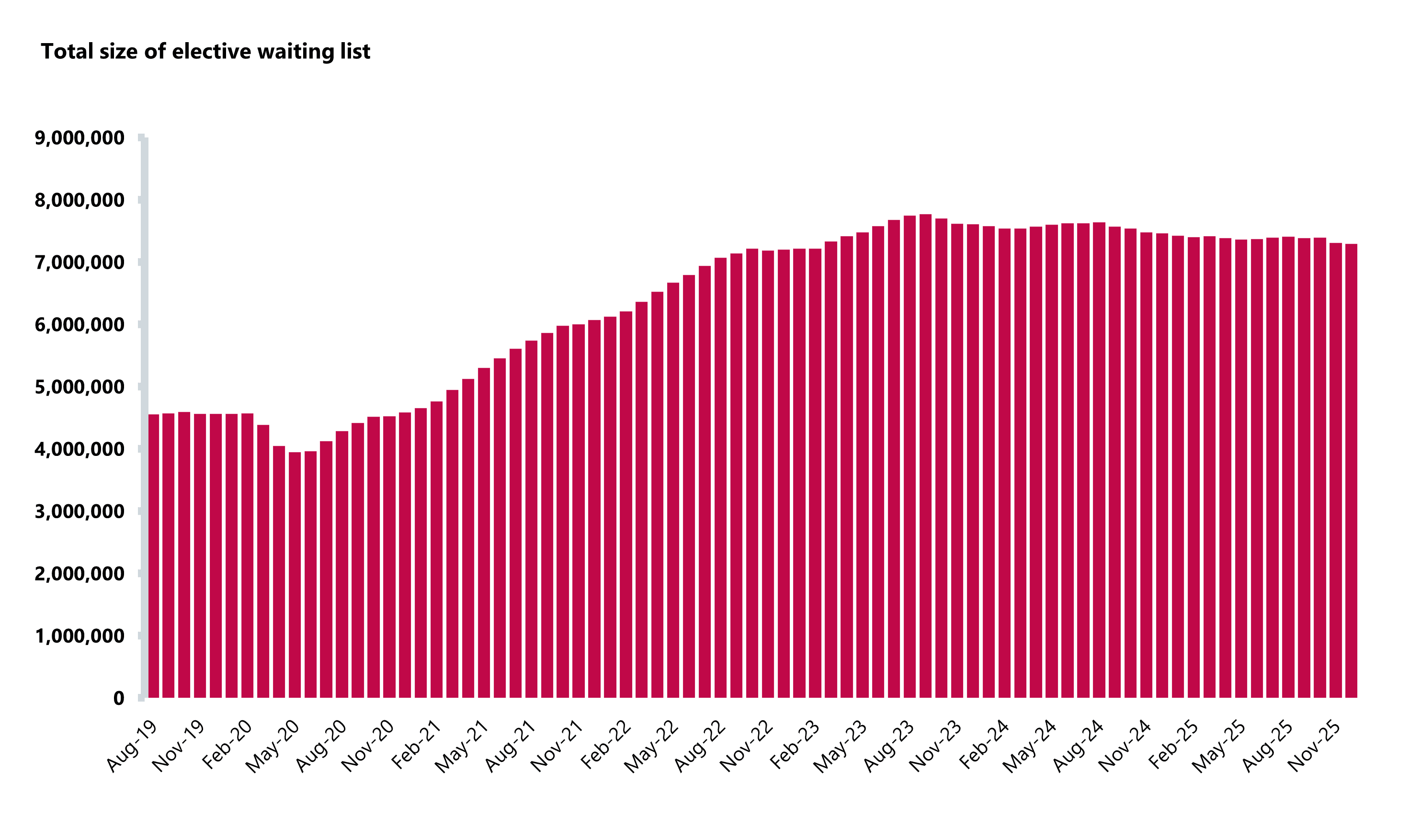
- The size of the waiting list decreased to 7.29 million in December, compared with 7.31 million in November. This is notably lower than the 7.46 million in December 2024, but the list remains significantly higher than before the pandemic (4.57 million in December 2019). This is shown in Figure 2.
- 84.6% of patients on the waiting list were unique patients. This is an estimated 6.17 million people.
- The number of cases waiting more than 18 weeks was 2.81 million, compared with 3.06 in December 2024.
- Waits within 18 weeks were equivalent to 61.5% of all the total, compared with 58.9% in December 2024. Further progress is needed to meet the planning guidance aim for 65% of treatments to be waiting no longer than 18 weeks by March 2026.
- Waits of over 52 weeks (140,508) have fallen from 200,402 in December 2024 and now account for 1.9% of all waits. The planning guidance sets out an aim for waits over a year to account for 1% of all waits by March 2026.
- 1.43 million cases were managed on the waiting list this month.
- Demand for elective care, measured by new cases added to the list (1.64 million cases) continued to outpace activity.
Figure 2
Total size of elective waiting list