NHS Digital workforce statistics – November 2025
28 November 2025
Workforce
Delivery and performance
On Thursday 27 November 2025, NHS Digital published their monthly data releases on NHS workforce statistics (August 2025), NHS sickness absence rates (July 2025), NHS vacancy data (Q2 2025/26) and NHS staff earnings estimates (12-month period from August 2024 to August 2025).
Key points
Workforce: The total NHS workforce stood at 1.37 million in August 2025, 1.9% more than in August 2024. This compares with a 3.9% rise between August 2023 and August 2024, indicating that workforce growth has slowed over the past year.
Sickness absence rate: The NHS sickness absence rate was 5.1% in July 2025, slightly lower than July 2024 (5.2%).
Vacancy data: The workforce had 100,020 vacancies in Q2 2025/26, a fall of 9% since last year. The vacancy rate was 6.7% – down from 7.4% last year.
Staff earnings estimates: The mean annual basic pay per full-time equivalent (FTE) in the 12 month period to August 2025 was £43,160, up by 10.7% on August 2024. For senior managers, it was £99,110, an increase of 9.7% since last year.
Workforce statistics (August 2025)
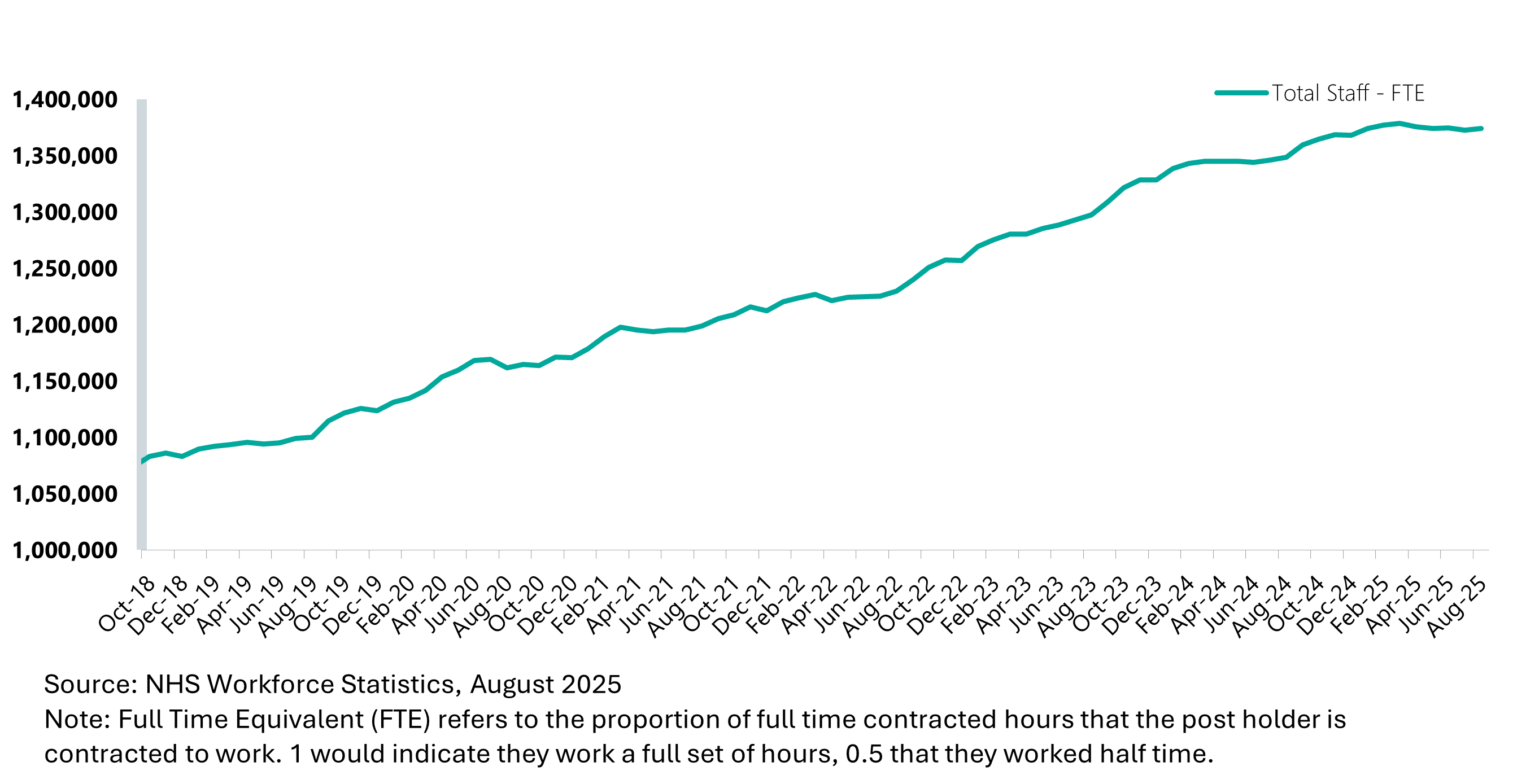
The total FTE workforce was 1.37 million in August 2025, up by 1.9% compared to last year. This compares with a 3.9% rise between August 2023 and August 2024. The chart below shows that since the start of 2025 workforce numbers have plateaued at around 1.37 million.
There were 151,980 FTE hospital and community health services doctors in August, a 4.8% increase compared to last year.
There were 367,510 FTE nurses and health visitors in August 2025, which is a 2.9% rise on last year.
FIGURE 1
Number of NHS England hospital and community health service staff (FTE), November 2018 to August 2025.
Sickness absence rates (July 2025)
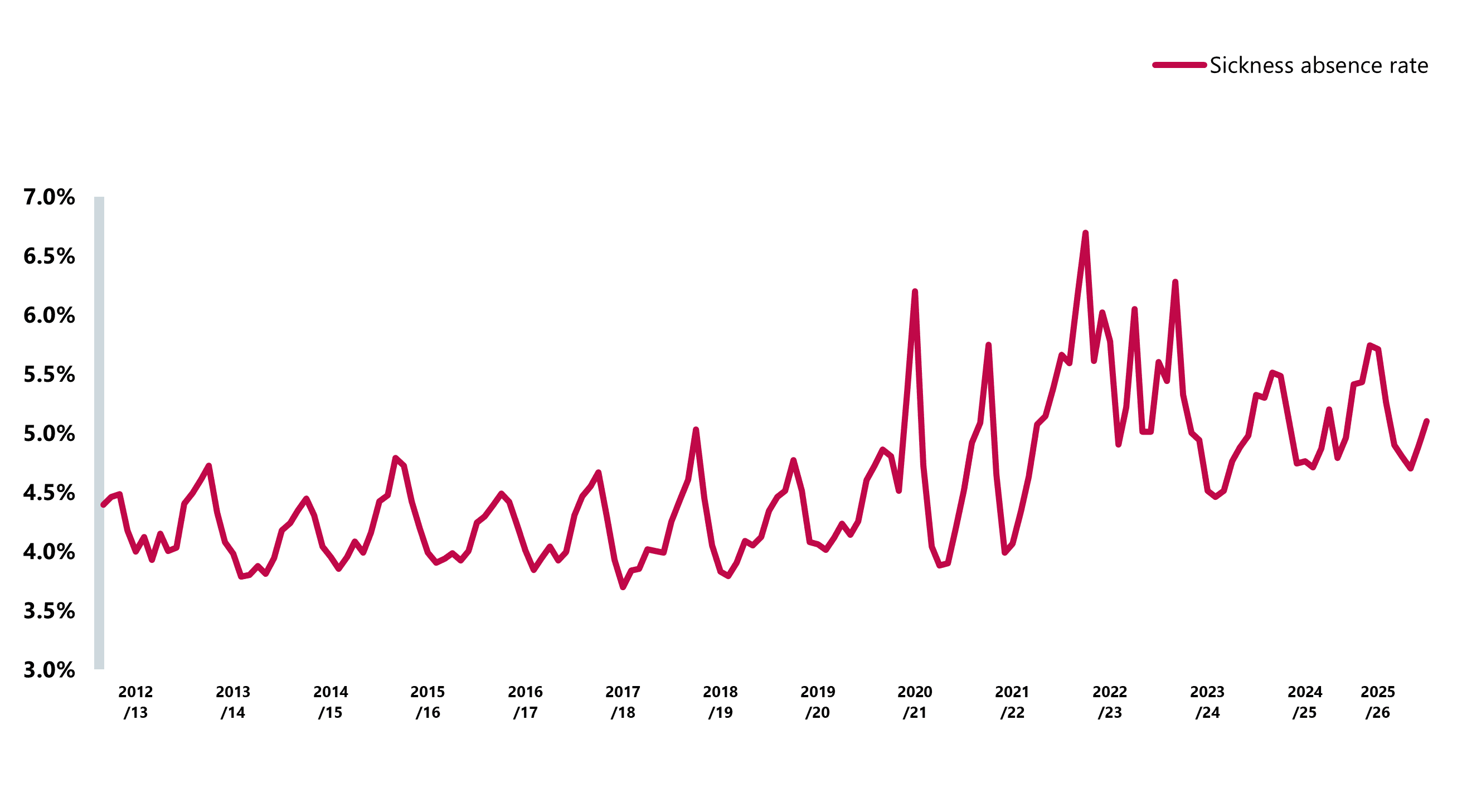
- The sickness absence rate was 5.1% in July 2025, slightly lower than July 2024 (5.2%)
- The North West region reported the highest sickness absence rate in July 2025 at 6%. The South East of England reported the lowest sickness absence rate in July 2025 at 4.5%.
- Ambulance trusts continue to report the highest sickness absence rate at 6.6% in July 2025.
- Anxiety/stress/depression/other psychiatric illnesses were the most reported reasons for sickness, accounting for over 694,800 full-time equivalent days lost and 30.3% of all sickness absence in July 2025.
FIGURE 2
Sickness absence rate (%), December 2011 to July 2025.
Vacancy data (Q2 2025/26 – as at September 30 2025)*
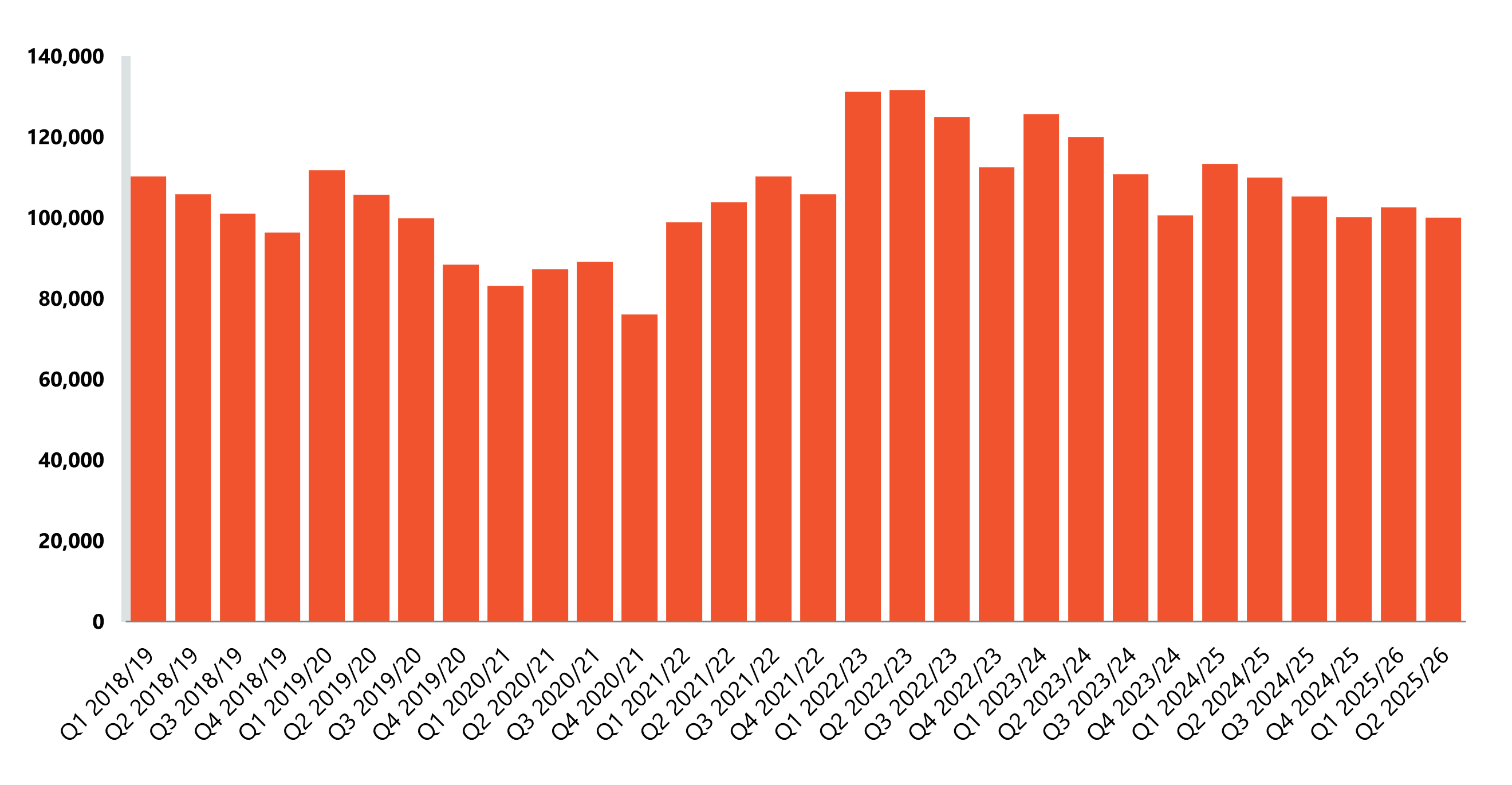
- In Q2 2025/26, the total number of vacancies decreased by 2.5% since the previous quarter to 100,020.
- The total workforce vacancy rate sits at 6.7%, a 0.2 percentage point decrease from the previous quarter and has fallen since last year (7.4%).
- The vacancy rate was highest in London (7.7%).
- Nursing: There were 25,500 nursing vacancies with a vacancy rate of 6%, lower than the rate seen in Q2 last year (7.5%).
- Medical: Since the previous quarter, the number of medical vacancies has fallen by 28.7% to 7,250. The total vacancy rate of 4.4% for medical staff, falling from 4.9% last year.
FIGURE 3
Total vacancies, September 2025.
*NHS vacancy statistics should be interpreted with care. A "vacancy" reflects the gap between funded posts and the number of permanent or fixed-term staff in post and therefore may include roles already covered by bank or agency staff.
Fifty-nine per cent of State of the provider sector respondents told us that they use a vacancy factor in budgets, 23% do not, and 18% didn't know. This is one example of how reporting practices, workforce planning, and workforce structures vary across organisations, which can affect data consistency. Because the figures are a snapshot at a point in time, they do not show whether posts are actively being recruited to, temporarily paused, or no longer required. As a result, vacancy statistics are a useful indication of workforce gaps but should not be treated as a complete measure of staffing shortfall or service pressure across the NHS.
Staff earnings estimates (August 2025)
- In the 12-month period to August 2025, the mean annual basic pay per FTE was £43,160 – 10.7% more than in August 2024.
The mean annual basic pay per FTE varied by staff group:
- For doctors, it was £90,290. This is 12.2% higher than a year ago.
- For nurses and health visitors it was £42,420. This is 9.6% higher than a year ago.
- For senior managers, it was £99,110, an increase of 9.7% since last year.
- For managers, it was £67,070, increasing by 11.8% since August 2024.
Staff earnings estimate for August 2025.