Targets and trade-offs: NHS finance and performance ambitions in 2026/27
Implications of the challenge
The tougher outlook for 2026/27 will have far-reaching consequences for
patients, staff and partner organisations.
Cuts and reductions to services
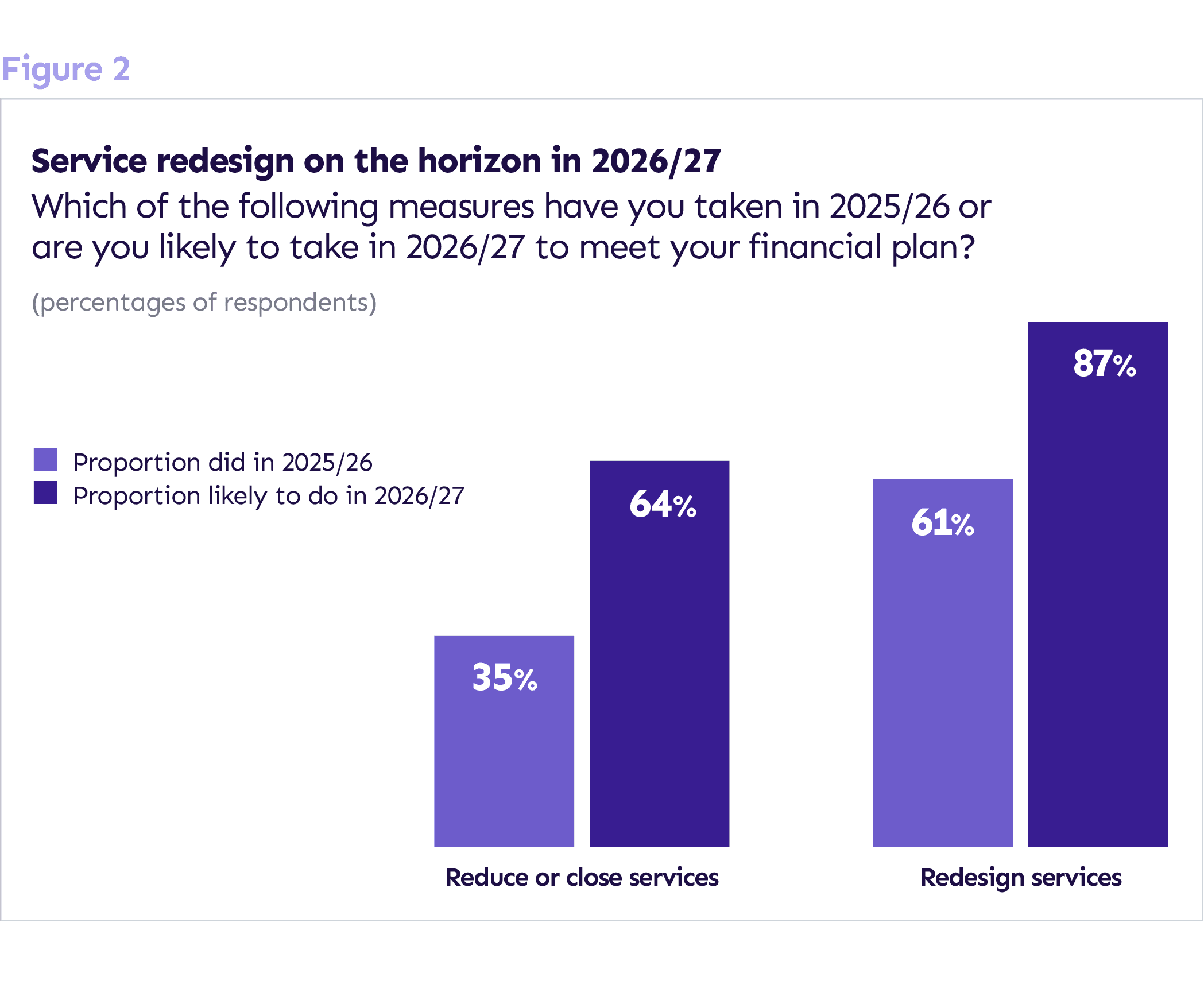
Trust and ICB respondents indicated that we are likely to see an increase in services being reduced or closed this year. More than a third (35 per cent) stated that their organisation cut services in 2025/26, with 64 per cent saying they expect to do this in 2026/27. There is also a greater likelihood that services will be redesigned: 61 per cent redesigned services in 2025/26 but 87 per cent suggested it is likely for 2026/27.
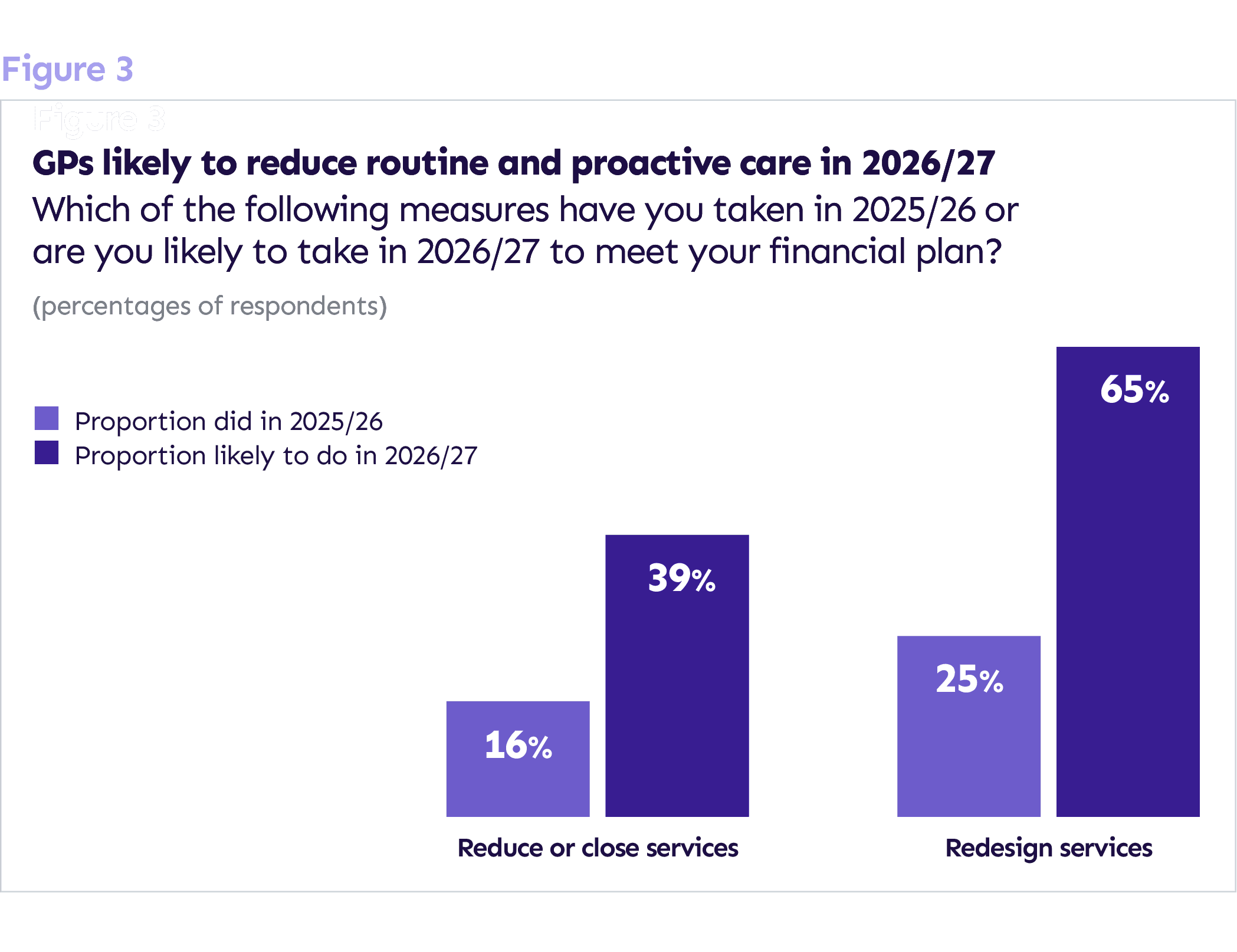
The GP survey suggested the same. In 2025/26, 16 per cent said they reduced or closed services, but 39 per cent said that it is likely in 2026/27. Similarly, in 2025/26, a quarter (25 per cent) said their organisation reduced routine and proactive care, but almost two-thirds (65 per cent) said this is likely for 2026/27.
GP leaders pointed to the shift of capacity and access funding away
from primary care networks (PCNs) in favour of a new practice-level GP
reimbursement scheme as an underlying factor. This move would reduce
flexibility and divert funding from at-scale services that support patient
flow and coordination. The practice-level funding is therefore unlikely to
deliver a meaningful improvement in patient access.
Housebound and centralised services such as phlebotomy, spirometry, vaccination services are likely to be cancelled.
Reducing, closing or redesigning services would have a major impact on
patients and communities at a time when the NHS is currently experiencing record levels of demand [3]. More than six in ten (64 per cent) trust and ICB respondents* and 74 per cent of GP respondents* are concerned about patient experience for 2026/27.
NHS services are being asked to make deep cuts across the board. At some point there will be consequences that will be felt by patients and their families.
NHS trust/foundation trust
Footnote
[3] For example, there are record numbers of GP appointments, A&E attendances and people in contact with mental health services.
Cuts to clinical and non-clinical staff
Respondents suggested there would be greater cuts to clinical staff in 2026/27 than last year. Over a third (35 per cent) of trust and ICB respondents took this action in 2025/26, but 57 per cent said they are likely to do it in 2026/27. Similarly, 28 per cent of GP respondents reduced clinical staff in 2025/26, but 52 per cent said they are likely to in 2026/27.
An even greater proportion said they are likely to cut non-clinical staff
(88 per cent of trust and ICB respondents and 61 per cent of GP respondents)
Operational performance
In 2025/26, the NHS made important progress on delivering key operational performance targets across urgent and emergency care, elective care and general practice. In March 2026, 77.1 per cent of patients were seen within four hours of attending A&E – the best performance since July 2021. The response times for category 2 ambulance incidents in March 2026 were the fastest they
have been in almost five years at 28 minutes and 18 seconds. For February 2026, 62.6 per cent of patients waited less than 18 weeks to begin treatment, which although still short of meeting the 65 per cent March 2026 target, represents a significant improvement on last year’s equivalent figure (59.2 per cent).
In primary care, GPs delivered 1.54 million appointments per working day in February 2026, compared with 1.48 million in February 2025, and delivered a record 39 million appointments in October 2025.
However, despite progress against key standards for 2025/26, 83 per cent* of trust and ICB respondents are concerned about planned care in 2026/27, and 78 per cent* are concerned about emergency care.
Similarly, GP respondents reported being worried about operational
performance in 2026/27. Nearly all (96 per cent*) were concerned about on-the-day access and 91 per cent* were concerned about routine and proactive care.
Reflecting on challenges in 2025/26, one respondent said it was difficult to balance online access with continuity of care; more funding would be needed to pay for additional staff to maintain quality while meeting the “relentless push” for same-day access (clinical director and divisional executive partner, PCN and GP federation).
Declining staff morale
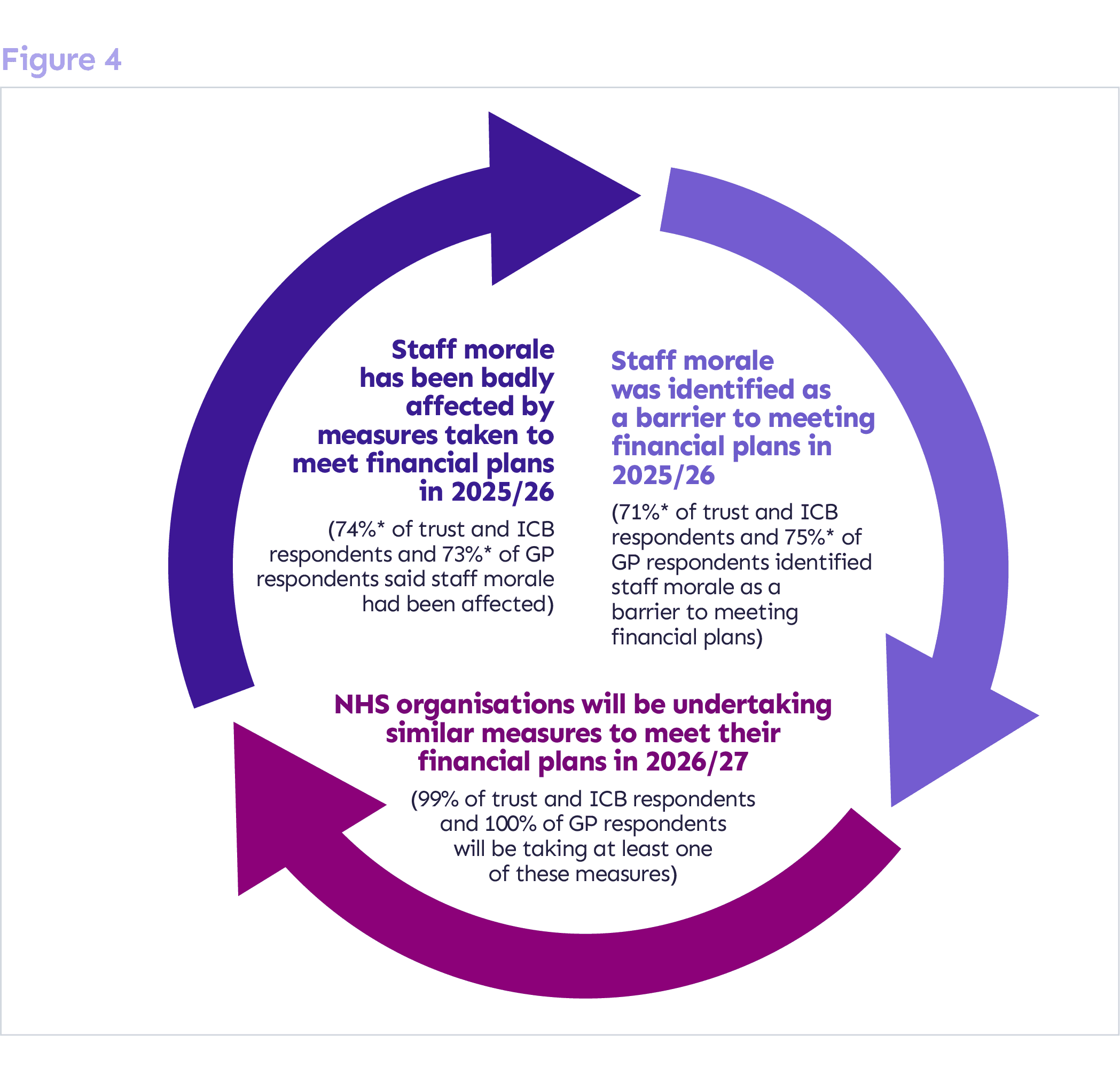
The survey suggests a negative cycle of financial savings impacting staff
morale, which in turn will make it increasingly difficult to deliver further savings.
Staff morale was identified as being both negatively affected by the measures taken to meet financial plans last year, and as a barrier to meeting financial plans in 2026/27. It is therefore probable that measures taken during 2026/27 will cause further deterioration in morale, which creates further barriers to meeting financial plans in 2026/27, creating a vicious cycle.
These findings come in the context of the 2025 NHS Staff Survey, published in March 2026, which showed a range of indicators of workload, burnout, and pressures on staff getting worse year on year, and falls in measures relating to engagement and morale.
The vast majority of respondents to both surveys were concerned about staff morale for 2026/27: 93 per cent* of trust and ICB respondents and 91 per cent* of GP respondents.