
Unlocking reform and financial sustainability: NHS payment mechanisms for the integrated care age
Enablers of payment reform
ICS leaders are willing to implement a new NHS payment system to deliver on their system objectives and priorities. However, payment mechanisms do not operate in a vacuum. The choice of payment mechanism alone is unlikely to be sufficient to achieve these desired outcomes. There are several factors which need to be in place to enable new payment mechanism to be used and to be effective, and they need a process to support their implementation.
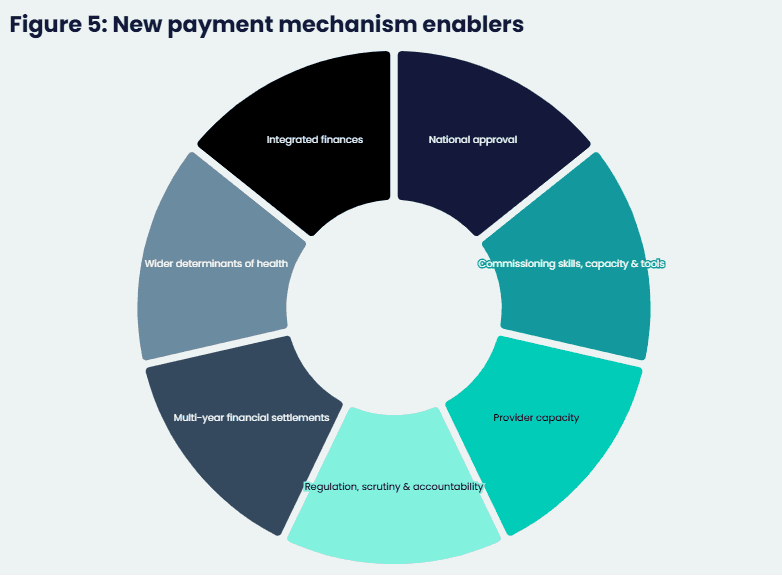
- National approval: While the current NHS Payment Scheme sets specific payment mechanisms for use across England for specific areas of care, it does permit that alternative local payment arrangements can also be made for services delivered by NHS trusts and foundation trusts with approval from NHS England. Collaboration with and approval from NHS England is therefore essential for any pilots or implementation. National policy should seek to provide flexibility, with the appropriate safeguards and assurances, to enable innovation, learning and improvement.
- Commissioning skills, capacity and tools: To effectively implement any such payment mechanisms, ICBs and any lead providers will require the appropriate skills and capacity among their workforce and digital and analytical tools. These would include far greater understanding of population health needs, robust analysis of relevant data to understand care pathways (best practices, costs and metrics to review), financial analysis and market management and contracting. This will help ensure ICBs can understand the impact of payment mechanisms and available resources are used most effectively. The planned reduction of ICBs’ running cost allowance (RCA) by 30 per cent by 2025 may also undermine their capacity to design innovative models, manage change and support service change. Although generating some small savings, these cuts risk a significant opportunity to cost to improve the value and efficiency of healthcare services.
- Provider capacity: Incentivising activity in certain providers does not necessarily translate into increased activity without the requisite capacity and capability to deliver that activity.105 The current NHS workforce is struggling to deliver activity in line with resources, with work currently underway to understand the underlying reasons for that. Loss of moral and exhaustion in the wake of COVID-19 and related rising sickness rates are likely a factor (and hindering productivity growth). However, unless the link between inputs and outputs is better understood and managed, there is a substantial risk that financial incentives will fail. [106] Adequate resourcing and the recruitment and retention of a well-trained, well-motivated workforce will be crucial. That said, recent growth in NHS hospital workforce without a corresponding increase in activity suggests that this may not be an obstacle at present. A greater problem may be historically low capital investment which has prevented providers from investing in the infrastructure (technology as well as buildings) they need to deliver efficient and effective care. [107]
- Regulation, scrutiny and accountability: The regulatory approach needs to be aligned with and support efforts to deliver a leftward/upstream shift towards more preventative care and not drive more investment in downstream demand at the expense of upstream need. NHS England and the Care Quality Commission have based their oversight approach on ICSs’ four purposes. It therefore follows that one of the determinants of a high-performing ICS should be progress towards shifting resources towards prevention, improving population health and tackling health inequalities. More broadly, a regulatory approach focused on peer review and driving improvement would be helpful and enable learning from and the spread of best practice payment mechanisms. Alongside regulation, ICSs need appropriate local governance structures to assess quality and performance. Meanwhile, national focus should similarly shift from measuring performance based on outputs and activities to have greater consideration of outcomes. Local systems should have the freedom to experiment and to shift their resources towards their priorities and be given the time to demonstrate impact.
- Multi-year financial settlements: Allocations of small, non-recurrent and ring-fenced funding pots can hinder ICBs’ ability to commission as effectively as possible and make best use of funds. Non-recurrent funding which reoccurs annually should be classed as what it is – recurrent funding. Short-term highly targeted allocations reduce efficiency and should stop. Instead, funding should be largely multi-year and recurrent mirroring Spending Review cycles. Early release of allocated funds to ICBs each year supplemented by three-year outline allocations can help them to plan investment most wisely. This would also enable ICBs to invest to save and realise productivity opportunities over multiple years – currently, any return on investment which falls outside of the annual financial planning cycle is disincentivised. Additionally, NHS funding cycles should also be aligned with local government, enabling joint, whole-system financial planning. This approach would enable ICSs to do longer-term planning and use their local knowledge of the populations they serve to allocate resources to where they can make the most impact.
- Wider determinants of health: Many challenges in demand and care prevention arise from wider determinants of health not being adequately addressed. This can include insufficient social housing provision and maintenance, public health measures and social care services, delivered by local authorities which are facing unprecedented pressures on their funding. The Local Government Association has warned that councils are “firmly in eye of inflationary storm” as local authorities face a funding gap of £4 billion over 2023-25 from cost and demand pressures. [108] Together with wider areas of public policy, including welfare and the economy, these factors can contribute to growing pressure on urgent and emergency care, hindering ICSs’ ability to shift resources towards more preventative and cost-effective interventions. This will require a cross-government national mission for health improvement, bring different departments and agencies together – mirroring the local system-level integration project at a national level.
- Integrated finances: Competing financial pressures on NHS and local government creates a risk of cost shunting, rather than collaboration, between the partners within ICSs. There are already several areas of budget pooling and risk sharing between the NHS and local government, such as the Better Care Fund, but there is increased scope for budget sharing using Section 75 arrangements, potentially including joint commissioner posts, to avoid cost shunting and enabling best use of collective resources across whole care pathways, covering primary and secondary prevention.
The enablers outlined above are long-standing and complex issues which will not be easily tackled. At the same time, ICS leaders cannot wait for the perfect conditions for payment reform. The drive to experiment with new payment mechanisms and to ensure implementation is as successful as possible may in fact lead to cultural and policy changes.